Bali, Rice Field

One of the many beautiful rice fields in Bali. The Balinese depend on these fields for food and a source of income.Agriculture still contributes to Bali's economy.

Credits to Pond spider, Flickr

Read more...

Bali arts festival

Bali arts festival is one the most widely celebrated and popular festivals in Bali.

Read more...

Bali, beaches

Bali has some the world's best beaches, known as a paradise to many, one has to visit Bali to understand its true beauty

Read more...

Bali, Souvenirs

With the tourism industry booming, one of the main source of income for the locals is through the sale of souvenirs

Bali, Kecak Dance

The Kecak dance, one the the most popular dances with tourist was created by Walter Spies a German artist. Watch the you tube video on my blog to find out more

Showing posts with label Arts of Indonesia. Show all posts
Thursday, December 9, 2010

Culture of Indonesia

Culture of Indonesia

Definition of culture by ICOMO:
Culture
can be defined as the whole complex of distinctive spiritual, material, intellectual and emotional features that characterise a community, society or social group. It includes not only arts and literature, but also modes of life, the

fundamental rights of the human being, value systems, traditions and beliefs. Culture encompasses the living or contemporary characteristics and values of a community as well as those that have survived from the past.


Credits by ubudhotelsassociation, Credits by mountainelm

Balinese Painting
Balinese painting can be traced back to the 17th century where Wayang Kulit figures were incorporated into paintings. These paintings are known from being inspired by the Wayang Kulit or shadow puppet theatre. They boast vibrant and alluring colours with many similarities to the colourful puppets shown in the Wayang Kulit.

Earliest Paintings
The earliest paintings were known as Kamasan or Wayang style. The themes of the painting were mainly from the Hindu epics, the Ramayana and Mahabharata. In the pats, these drawings were
drawn on cloth or bark paper (Ulantaga paper) with natural dyes. The colours were also limited and artists had to strictly adhere to certain rules as these paintings were mostly produced for religious articles and temple hangings.

Twentieth Century
In the early twentieth century, western artists such as German, Walter Spies, and the Dutch artist, Rudolf Bonnet moved to Ubud. The western artists had encouraged the Balinese to go outside of the box and not adhere to the rules, this lead to a new generation of Balinese artists. In 1936, Walter Spies and Rudolf Bonnet founded an association known as Pita Maha which had been devoted to the development of the arts in Ubud. However this association no longer exists because it was dismantled due to the World War two. Pita Maha had been a great influence as artists had created their own styles overtime due to the association.

From 1950s to now
A new style emerged in the 1950s due to the influence of Dutch painter, Arie Smit. These paintings were referred to as the naive or young artist’s style and became popular among tourists.

Credits to visionbaliexport

Carvings
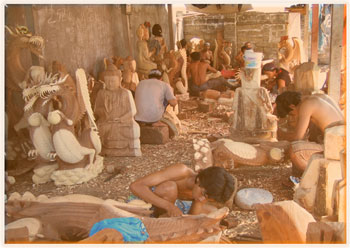
Another common site in Bali is the beautiful carvings found almost everywhere. In the past, stone was used for carvings in temples and buildings. However, due to the nature of soft volcanic paras used in carvings of buildings, they would deteriorate overtime. The high demand by tourist for carvings let to carvers carving on wood which was more duarable.

Initially, the woodcarvers were Brahmana whom were dedicated to carving for rituals, these tradition was passed down to their sons. However because of the influences of Pita Maha, just like paintings, carvers begin to carve daily scenes. Now carvings are mass produced and sold almost everywhere on the island. A tourist would be able to get it from shops in hotel lobbies or souvenir shops in touristy areas.


Credits to balicheaphotels


Changes to painting and cravings
Unlike the olden days where few versions of similar paintings were available for sale and one had to travel to specific places for paintings, it is now widely available. Because of the mass production of both paintings and cravings, they can be easily found in tourist shops or even peddled by sellers on the roadsides. Because of the high demand of carvings, it has led to Jati', or teakwood which used to grow in forests in the north of Bali decreasing rapidly. Large portions of this wood have been wiped out by the demand for wood.

In Ubud, tourists are able to buy batik hangings which can be found in almost every shop. Paintings and cravings are now mostly created for sale. In addition Bali also exports handicrafts. These painting and cravings are in high demand because tourists perceive that these souvenirs represent the Balinese culture. They associate the Balinese culture with these mass produced objects thinking that by purchasing it, it will signify that they had visited Bali.

As an example, Sepik carvings, the souvenirs of Cannibal Tours, were originally used in ritual contexts. At the end of the 19th century, however, they were designated ‘primitive art’ by western explorers, and were seen as having objective, ‘authentic’ value by western scholars. Now they have been transformed into ‘touristic art,’ by being taken up by the tourist guidebooks to be sold to tourists.

Leia Mais…

Culture of Indonesia

Culture of Indonesia

Definition of culture by ICOMO:
Culture
can be defined as the whole complex of distinctive spiritual, material, intellectual and emotional features that characterise a community, society or social group. It includes not only arts and literature, but also modes of life, the fundamental rights of the human being, value systems, traditions and beliefs. Culture encompasses the living or contemporary characteristics and values of a community as well as those that have survived from the past.

Arts of Indonesia

World Heritage Sites

As a cultural tourist, one should definitely visit Indonesia as it houses 7 United Nation Educational Scientific and Cultural Organisation (UNESCO) world heritage sites in Indonesia. 3 out of the 7 sites are natural.

  1. Borobudur Temple Compounds
  2. Komodo National Park
  3. Prambanan Temple Compounds
  4. Ujung Kulon National Park
  5. Sangiran Early Man Site
  6. Lorentz National Park
  7. Tropical Rainforest Heritage of Sumatra

Borobudur Temple Compounds
Borobudur which is located in Yogyakarta, is the largest Buddhist monument in the world. The Buddhist Borobudur was built between AD 750 and 842. However it was only rediscovered in 1814 as it was hidden under volcanic ash.

The whole structure is in the form of a lotus, the sacred flower of Buddha.
A restoration program undertaken between 1973 and 1984 returned much of the complex to its former glory, and the site has since become a destination of Buddhist pilgrimage.

Credits to .buddhistchannel.tv

It was recently reported by Jakarta post on 21 of February 2010 that the University of Indonesia (UI) and PT Taman Wisata Candi (TWC) have decided to sign a MoU to preserve and further develop the national heritage sites of Borobudur, Prambanan and Boko temples. One of measures to preserve the sites, which began on Feb. 1 was the implementation of visitors wearing batik sarongs. As Borobudur is a sacred site, visitors are expected to show their respect in terms of behaviour and dressing. In addition, visitors are also required to wear rubber sandals to minimize the impacts of the footprints. Visitors can either to choose to rent or purchase these items.

Komodo National Park

The Komodo National Park located in Nusa Tenggara was founded in 1980. It is a home to Komodo dragons which is found nowhere else on earth and many other species, marine or otherwise. The park was initially set up by the Indonesian government to protect about 2,500 specimens of world's largest living lizard within its borders.

In 1996, the Indonesian government invited The Nature Conservancy to help with the managing of the park. New and creative strategies that protect the biodiversity and allow people to enjoy the park are constantly being implemented, this includes:

Credits to moreindonesia.com

  • Carefully managed ecotourism;
  • Alternative livelihoods for local people; and
  • Collaborative protection strategies, such as anti-poaching patrols.

Thus the Conservancy decided to join hands with the World Bank’s Global Environment Facility (GEF) to create Putri Naga Komodo (PNK). PNK helps the Indonesian government successfully implement the strategies mentioned above.

Bali
Bali has many cultural sites as well. The island is rich in culture and attracts numerous cultural tourists.

Traditional rice fields Jatiluwih, Credits to vvipheaventour88

Bali proposes 3 heritage sites to UNSECO

As mentioned in an article published on 21 December 2009 in Jakarta Post, Indonesia has decided to propose 3 historical sites located in Bali for the upcoming 2010 selection process by UNSECO. The three sites include the Pakerisan Riverbed in Gianyar, traditional rice fields Jatiluwih and Taman Ayun Temple in Mengwi, Badung regency.

As mentioned by Director General for History and Archaeology Hari Untoro Drajat, "The three sites have strategic value to safeguard Bali's culture, traditions and environment,"

These 3 sites were chosen by the government as it is said that they clearly portray the lives of the Balinese people and their tradition and culture during the Tri Hita Karana era, which focused on harmonious relations between nature, the people and the Creator.

Dewa Wisnu, Credits to B10m Garuda Bird, credits to wibowo rusli

Garuda Wisnu Kencana Cultural Park

Garuda Wisnu Kencana Cultural Park situated in Bali houses the
unfinished statue of Dewa Wisnu/ Garuda designed by Balinese artist Nyoman Nuarta. Once completed, the statue would be 140 metres high, even taller than the statue of liberty. The statue is expected to use up about 4,000 tons of brass and copper.

The park when completed is envisioned to consist of Festival Park, an exhibition hall, a lotus pond, and so many other facilities on site. Despite many looking forward to the complete of the statue, it has sparked off much controversy. It has been said that Bali is imitating Disneyland trying to make the Garuda bird and Bali world famous. When one thinks if Disney land, the iconic Mickey Mouse house comes to mind. That is what Bali is trying to do. The governor, Ida Bagus Oka even compares the sculpture to the Eiffel tower in Paris. Although some see the modern sculpture as a reflection of modern Bali, others perceive otherwise and categorise it as another tourist attraction.

It is expected that once Bali has successfully related Garuda to the city, tourists can be sure to look out for the merchandise. Key chains, cups, and merchandise bearing the image of the Garuda would be snapped up as tourists want to show others they had visited Bali. In this way not only would tourist associate Garuda with Bali but it is also a new source of revenue.

Leia Mais…